

Stormwater Forebays: Purpose, Function, and Maintenance Needs
Stormwater systems are designed to manage runoff, protect downstream waterways, and maintain regulatory compliance. But no matter how advanced the treatment practice, its long-term performance often depends on one simple feature working properly: the stormwater forebay.
Forebays are not flashy. They’re not typically visible from the surface in a meaningful way. And they rarely get attention – until they’re full of sediment and the entire system starts to underperform.
For commercial property managers, HOAs, developers, and government contractors, understanding the purpose, function, and maintenance requirements of stormwater forebays is critical to protecting infrastructure and staying compliant.
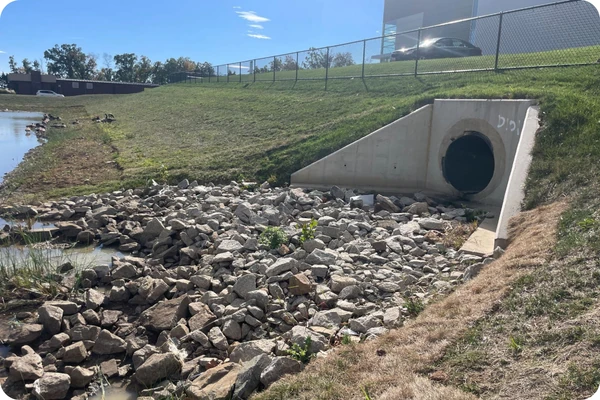
What Is a Stormwater Forebay?
A stormwater forebay is a small, separate basin located at the inlet of a larger stormwater management practice – most commonly a detention pond, retention pond, or bioretention facility.
Its primary role is simple: capture and concentrate sediment and debris before runoff enters the main treatment area.
Forebays are typically separated from the main basin by a berm, concrete weir, riprap check structure, or other hardened transition. By isolating incoming sediment in one accessible location, they help preserve the design volume and treatment efficiency of the primary facility.
Why Forebays Matter in Stormwater Design
Most modern stormwater management systems – particularly those designed under post-2000 regulations – include forebays as a best management practice (BMP) component.
They are commonly installed upstream of detention ponds, retention ponds, infiltration basins, bioretention facilities, and constructed wetlands.
Their importance comes down to three core functions:
Sediment Control
Stormwater runoff carries soil particles, organic debris, road grit, and trash. If these materials enter the main basin unchecked, they reduce storage volume, impair infiltration, and increase long-term maintenance costs.
A properly functioning forebay acts as a sacrificial sediment trap, designed to fill first and be cleaned out more frequently than the primary facility.
Protecting Water Quality Performance
Stormwater facilities are engineered to meet specific pollutant removal standards under local and state regulations.
When sediment accumulates beyond design capacity, hydraulic residence time decreases and pollutant removal efficiency declines. Over time, this can affect compliance with MS4 permits and other regulatory requirements.
By trapping coarse sediment early, the forebay protects downstream treatment processes and supports overall water quality performance.
Extending System Lifespan
Sediment that bypasses a forebay settles in areas that are harder to access and more expensive to dredge. Routine forebay cleanouts are significantly less disruptive and far more cost-effective than full basin restoration.
For property owners and public entities alike, this is a long-term asset protection strategy – not just routine maintenance.
How a Stormwater Forebay Works
The function of a forebay relies on basic hydraulic principles.
Runoff enters at the inlet structure and slows as it spreads into the forebay. As velocity decreases, heavier sediment particles settle out due to gravity. Partially treated water then passes over a weir or through a stabilized outlet into the main basin.
Forebays are generally designed to:
- Be easily accessible for maintenance equipment
- Withstand repeated cleanouts
- Capture a defined portion of incoming sediment before it reaches the primary facility
When functioning properly, the majority of coarse sediment remains confined to the forebay, protecting the rest of the system.
Signs a Forebay Needs Maintenance
Forebays are designed to accumulate sediment – that is their purpose. The issue arises when they are not cleaned at appropriate intervals.
Warning signs often include:
- Sediment filling a significant portion of the forebay depth
- Trash and debris buildup at the inlet
- Vegetation growing in accumulated sediment
- Evidence of sediment migrating into the main basin
Many jurisdictions require sediment removal once it reaches a specified percentage of design depth, as outlined in the approved stormwater maintenance agreement.
Forebay Maintenance Best Practices
Forebay maintenance should be proactive rather than reactive.
Routine Inspections
Forebays should be inspected after major storm events and at least annually. Sites with active construction nearby, steep slopes, or high traffic areas may require more frequent evaluation due to increased sediment loads.
Sediment Removal
Sediment is typically removed using excavation equipment or vacuum systems, depending on the size and accessibility of the forebay. Removed material must be disposed of in accordance with local environmental regulations.
Structural Repairs
Maintenance may also involve repairing concrete weirs, replacing displaced riprap, stabilizing eroded slopes, or restoring access paths. Addressing minor structural issues early helps prevent more significant failures later.
Regulatory Considerations in Maryland, Northern Virginia, DC, and Delaware
Across the Mid-Atlantic region, stormwater facilities are subject to inspection and maintenance requirements under local ordinances, state environmental agencies, MS4 permit programs, and recorded maintenance agreements tied to property deeds.
Failure to maintain BMPs – including forebays – can result in violation notices, fines, or mandated corrective action. In some cases, it may affect project approvals or occupancy certifications.
Forebays are not optional maintenance items. They are a documented component of the approved stormwater system and must be maintained accordingly.
The Cost of Deferred Forebay Maintenance
When forebays are ignored, sediment bypasses into the main pond or treatment area. Over time, this can lead to reduced capacity, clogged infiltration systems, declining water quality performance, and costly dredging projects.
What could have been a targeted cleanout becomes a capital restoration effort.
For commercial property managers, multifamily communities, retail centers, industrial facilities, and government properties, proactive forebay maintenance protects both infrastructure and budgets.
Final Thoughts: Small Component, Major Impact
Stormwater forebays are simple by design – but critical in function.
They concentrate sediment, protect treatment performance, extend facility lifespan, and support regulatory compliance. Like most stormwater infrastructure, they perform best when inspected consistently and maintained before problems escalate.
If your property includes detention ponds, retention basins, or bioretention facilities, reviewing the condition of your forebays should be part of your annual stormwater strategy – not an afterthought.
📞 Call us at (410) 231-3455 or 💬 Contact us online.



Real Results
iStormwater LLC was an excellent choice. They made the process of the Stormwater pond repairs seamless. They took charge of the project and got the project approved and passing the inspection. We highly recommend them and would use them again.
Incredible stormwater management service. The owner John consulted on a property I manage and ended up saving us thousands of dollars in environmental fees from the government. Now, our property is compliant with the EPA and we have a great partner to keep us maintained on stormwater regulations over time.
So helpful with all of my water issues.
Great communication and leadership and a family friendly atmosphere. Thank you John!
Stormwater systems are designed to move water efficiently away from paved surfaces, structures, and landscaped areas. When they stop draining properly, the issue is rarely...
- Annapolis
- Anne Arundel County
- Baltimore County
- Baltimore
- Bel Air South
- Bethesda
- Bowie
- Cecil County
- Charles County
- Columbia
- Gaithersburg
- Glen Burnie
- Howard County
- Montgomery County
- Pasadena
- Prince George’s County
- Rockville
- Severna Park
- St. Mary’s County