

Stormwater Pipe Damage: Common Causes, Warning Signs, and Repair Options
Stormwater pipes are designed to move runoff safely through a property, often without much attention until something goes wrong. Because much of this infrastructure is underground, however, deterioration can develop long before a pipe collapses or a drainage problem becomes obvious at the surface.
Cracks, separated joints, root intrusion, corrosion, soil movement, and other conditions can gradually affect a stormwater pipe’s ability to function as intended. In some cases, relatively minor defects can also allow water or surrounding soil to move where it shouldn’t, contributing to erosion, settlement, recurring blockages, or more extensive structural damage.
Understanding what causes stormwater pipe damage – and recognizing the warning signs early – can help property owners and managers make better decisions about inspection, maintenance, rehabilitation, and repair.
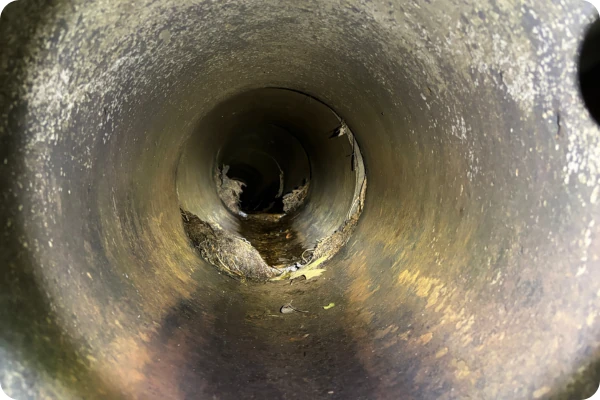
What Causes Stormwater Pipe Damage?
There isn’t one universal cause of stormwater pipe failure. Pipe material, age, installation, surrounding soil, loading conditions, vegetation, and water movement can all influence how underground infrastructure performs over time.
Often, several factors are involved.
Joint Separation and Joint Failure
Joints connect individual sections of stormwater pipe and can become vulnerable points as a system ages.
Settlement, soil movement, improper installation, deterioration of joint materials, or movement of the pipe itself can cause joints to separate or become misaligned. Once a joint is no longer properly connected or sealed, it can create an opening between the pipe and the surrounding soil.
This can lead to several problems, including:
- Water escaping from the pipe
- Groundwater or soil entering the pipe
- Sediment accumulation
- Voids developing around the pipe
- Root intrusion
- Progressive loss of structural support
A separated joint may begin as a relatively localized defect but can become more significant if surrounding material continues to migrate.
Tree-Root Intrusion
Tree roots are frequently blamed for “breaking” underground pipes, but root intrusion often begins because the pipe already has a vulnerability.
Roots can enter through cracks, separated joints, deteriorated connections, or other existing openings. Once inside, they can continue growing and create increasingly significant problems.
Root masses may restrict flow and provide a place for sediment, leaves, and other debris to collect. Continued root growth can also worsen an existing opening or joint defect.
Removing the roots may restore flow temporarily, but it does not necessarily correct the reason they entered the pipe. If an underlying crack or failed joint remains, root intrusion can recur.
For that reason, roots inside a stormwater pipe should be viewed as more than an obstruction. They can also be an indicator of an existing pipe defect that warrants further evaluation.
Cracks and Fractures
Stormwater pipes can develop cracks for a variety of reasons, including ground movement, loading, installation problems, material deterioration, or loss of support around the pipe.
Not every crack indicates immediate pipe failure. The location, size, orientation, and surrounding conditions all matter.
However, cracks can create pathways for water, roots, and soil. As those conditions progress, a relatively small defect may contribute to more extensive deterioration.
Corrosion and Material Deterioration
Different stormwater pipe materials deteriorate in different ways.
Metal pipe, including corrugated metal pipe (CMP), can experience corrosion that gradually reduces wall thickness and structural integrity. The bottom, or invert, of the pipe can be particularly vulnerable where water and sediment regularly collect.
Other pipe materials can experience cracking, joint problems, deformation, abrasion, or other forms of deterioration depending on their age, installation, and site conditions.
Understanding the pipe material is an important part of determining the extent of damage and the appropriate repair method.
Soil Settlement and Ground Movement
A stormwater pipe depends on the surrounding soil and bedding for support. When those conditions change, the pipe can move with them.
Poor compaction, erosion, saturated soils, freeze-thaw cycles, nearby construction, and natural settlement can contribute to pipe displacement or joint separation.
Movement doesn’t have to be dramatic to cause problems. Even relatively small changes in alignment can affect joints, pipe slope, and drainage.
Soil Loss Around the Pipe
Pipe defects can sometimes lead to a problem outside the pipe that is just as important as what is happening inside it.
If water moves through a crack, failed joint, or other opening, surrounding soil may gradually migrate into the stormwater system. This can create voids around the pipe and reduce the support provided by the surrounding material.
At the surface, that process may eventually appear as settlement, depressions, erosion, or even sinkholes.
Visible surface damage near an underground stormwater alignment should therefore be investigated rather than automatically treated as a landscaping issue.
Excessive Loads and Construction Activity
Stormwater infrastructure can also be damaged by loads it was not designed to withstand.
Heavy equipment, construction traffic, changes in finished grade, or other activity above an underground pipe can increase loading. Depending on pipe depth, material, condition, and installation, excessive loads may contribute to cracking, deformation, joint movement, or collapse.
This is particularly important during redevelopment or construction on an existing property, where older stormwater infrastructure may remain in place beneath areas experiencing new activity.
Stormwater Pipe Damage Does Not Always Mean Collapse
A collapsed pipe is one of the most obvious forms of stormwater pipe failure, but it is far from the only one.
A pipe can remain physically open while still having significant defects.
For example, a separated joint may allow surrounding soil into the system. A cracked pipe may continue conveying runoff while erosion develops around its exterior. Root intrusion may gradually reduce available flow area. Corrosion may significantly weaken a pipe before a section visibly fails.
That makes pipe condition, rather than simply whether water is still moving through it, an important consideration.
A stormwater system that “still drains” is not necessarily a stormwater system without damage.
Warning Signs of Stormwater Pipe Damage
Because stormwater pipes are often buried, the first signs of damage may appear somewhere else on the property.
Conditions that may warrant further investigation include:
- Recurring drainage problems
- Water backing up at inlets
- Unexplained standing water
- Repeated sediment accumulation
- Recurring pipe blockages
- Soil settlement or depressions
- Sinkholes developing near a pipe alignment
- Erosion around structures, outfalls, or pipe connections
- Exposed or displaced pipe sections
- Visible cracks or separated joints
- Roots growing into accessible pipes or structures
- Rust, corrosion, or deterioration visible at pipe ends
- Areas that repeatedly require the same maintenance
None of these conditions alone proves that a pipe is structurally damaged. Blockages, grading problems, inadequate capacity, and other stormwater issues can produce similar symptoms.
The goal is to determine why the problem is occurring, rather than repeatedly addressing the surface symptom.
Why Recurring Stormwater Problems Deserve a Closer Look
Repeated maintenance in the same location can provide an important clue.
Consider a pipe that repeatedly fills with sediment. Removing the sediment restores flow, but several months later the same section is full again.
The sediment itself may not be the primary problem.
A failed joint or crack could be allowing surrounding soil into the pipe. Until that defect is corrected, cleaning removes the material but not its source.
The same applies to recurring root intrusion and debris accumulation.
When the same problem repeatedly returns, further investigation can help distinguish a routine maintenance need from an underlying infrastructure defect.
How Stormwater Pipe Damage Is Identified
Some pipe problems can be identified through visual inspection of accessible inlets, manholes, outfalls, and structures. Underground sections are more difficult.
When conditions inside a pipe need to be evaluated, CCTV inspection can be used to document the interior of the pipeline.
A camera inspection may reveal:
- Cracks and fractures
- Separated or offset joints
- Root intrusion
- Corrosion
- Pipe deformation
- Missing or deteriorated pipe material
- Sediment and debris
- Standing water
- Soil entering through defects
- Partial or complete obstructions
The location and severity of these observations help determine what should happen next.
For example, finding roots tells part of the story. Finding that those roots are entering through a substantially separated joint provides much more useful information for planning a repair.
Similarly, sediment inside a pipe may initially appear to be a cleaning issue. If CCTV inspection reveals soil entering through a damaged section, structural repair may need to be considered.
Maintenance Problem or Repair Problem?
One of the most important distinctions in stormwater pipe management is determining whether the problem can be corrected through maintenance or whether the infrastructure itself needs repair.
Maintenance addresses conditions affecting an otherwise functional system.
Examples may include sediment, leaves, trash, or other accumulated debris that needs to be removed to restore flow.
Repair addresses a defect in the infrastructure itself.
Examples include cracked pipe, separated joints, significant corrosion, deformation, or damaged connections.
The two can also occur together.
A damaged joint may allow sediment into the pipe, creating a blockage. Cleaning may be necessary before the pipe can be inspected or repaired, but cleaning alone does not correct the joint.
This distinction helps explain why some drainage problems return even after a pipe has been thoroughly cleaned.
Stormwater Pipe Repair Options
There is no single repair method that is appropriate for every damaged stormwater pipe.
The right approach depends on factors such as:
- Pipe material
- Diameter
- Length of the damaged section
- Type and severity of the defect
- Structural condition
- Accessibility
- Surrounding utilities
- Depth
- Surface conditions
- Hydraulic requirements
- Whether the pipe can support rehabilitation
Depending on those conditions, repair may involve one of several approaches.
Localized Pipe or Joint Repair
When damage is limited to a particular location, it may be possible to repair the affected section or connection rather than rehabilitating the entire pipe.
This can be appropriate for isolated joint failures, damaged connections, or localized defects when the remaining pipe is in suitable condition.
Trenchless Pipe Rehabilitation
Some damaged stormwater pipes can be rehabilitated using trenchless methods that reduce the amount of excavation required.
Depending on the pipe and site conditions, lining or sliplining techniques may provide a new or rehabilitated interior flow path while allowing much of the existing pipe alignment to remain in place.
Trenchless rehabilitation can be particularly useful beneath pavement, developed areas, or other locations where extensive excavation would be disruptive.
However, not every damaged pipe is a candidate. The existing pipe condition, available diameter, access, alignment, and nature of the failure all need to be considered.
Excavation and Replacement
More extensive damage may require excavation.
Pipe replacement may be appropriate when a section has collapsed, is severely displaced or deformed, has lost significant structural integrity, or cannot reasonably be rehabilitated using another method.
Excavation may also be necessary when surrounding soil conditions or voids need to be addressed as part of the repair.
Why Early Investigation Can Provide More Repair Options
Waiting for a stormwater pipe to collapse before investigating it can limit repair options.
Earlier-stage defects may sometimes be addressed through localized repairs or rehabilitation. Once a pipe becomes severely deformed, displaced, collapsed, or surrounded by significant soil loss, more extensive excavation and reconstruction may be required.
Early investigation can also help property managers plan rather than react.
Instead of discovering a major underground failure during a storm or after a sinkhole develops, identifying deteriorating infrastructure can provide time to evaluate alternatives, obtain proposals, budget for repairs, and coordinate the work around property operations.
Preventing Stormwater Pipe Problems
Not every pipe defect is preventable, particularly as infrastructure ages. However, proactive stormwater management can help identify developing problems earlier.
Property owners and managers can reduce risk by:
- Maintaining accessible inlets, manholes, and other structures
- Addressing recurring blockages rather than repeatedly cleaning them without investigation
- Watching for unexplained erosion and settlement
- Considering underground stormwater infrastructure during construction and landscaping projects
- Keeping large woody vegetation in mind when planning around pipe alignments
- Documenting recurring drainage problems
- Inspecting aging infrastructure when warning signs develop
- Repairing identified defects before surrounding conditions worsen
Most importantly, changes in stormwater performance shouldn’t automatically be dismissed as the result of a particularly heavy storm.
A new drainage problem can be an indication that something within the system has changed.
When Should a Stormwater Pipe Be Evaluated?
Stormwater pipe evaluation may be appropriate when a property experiences recurring drainage issues, repeated blockages, settlement, sinkholes, unexplained sediment, visible deterioration, or other signs that underground infrastructure may be compromised.
An evaluation does not automatically mean a major repair is necessary.
In some cases, the issue may be corrected through routine maintenance. In others, identifying a localized defect early may make a more targeted repair possible.
The important step is determining the condition and cause of the problem before deciding how to address it.
Stormwater Pipe Inspection and Repair
Underground stormwater pipe damage can progress quietly. A system may continue moving runoff even while cracks, failed joints, root intrusion, corrosion, or soil loss are developing below the surface.
Identifying the underlying problem helps property owners move beyond repeatedly treating symptoms and determine whether maintenance, targeted repair, rehabilitation, or replacement is the appropriate next step.
iSTORMWATER provides stormwater system inspections, CCTV pipe inspections, maintenance, rehabilitation, and repair services for commercial properties and communities throughout Maryland, Washington, DC, Northern Virginia, and Delaware.
If you are experiencing recurring drainage problems or are concerned about damaged stormwater infrastructure, contact iSTORMWATER to schedule an evaluation.
📞 Call us at (410) 231-3455 or 💬 Contact us online.



Real Results
iStormwater LLC was an excellent choice. They made the process of the Stormwater pond repairs seamless. They took charge of the project and got the project approved and passing the inspection. We highly recommend them and would use them again.
Incredible stormwater management service. The owner John consulted on a property I manage and ended up saving us thousands of dollars in environmental fees from the government. Now, our property is compliant with the EPA and we have a great partner to keep us maintained on stormwater regulations over time.
So helpful with all of my water issues.
Great communication and leadership and a family friendly atmosphere. Thank you John!
Buying a commercial property means evaluating much more than the building, parking lot, roof, utilities, and financials. The property's stormwater management system can carry its...
- Annapolis
- Anne Arundel County
- Baltimore County
- Baltimore
- Bel Air South
- Bethesda
- Bowie
- Cecil County
- Charles County
- Columbia
- Gaithersburg
- Glen Burnie
- Howard County
- Montgomery County
- Pasadena
- Prince George’s County
- Rockville
- Severna Park
- St. Mary’s County