

Stormwater Due Diligence When Buying Commercial Property
Buying a commercial property means evaluating much more than the building, parking lot, roof, utilities, and financials. The property’s stormwater management system can carry its own maintenance requirements, repair needs, compliance obligations, and long-term costs – and those responsibilities may transfer to the new owner.
A detention pond that has not been maintained, an underground filtration system with overdue service, a damaged outfall, or an unresolved stormwater deficiency can quickly become an unexpected expense after closing.
That is why stormwater due diligence should be part of the commercial property acquisition process, particularly for properties with privately maintained stormwater management facilities.
Before purchasing a commercial property, buyers should understand what stormwater infrastructure exists, who is responsible for it, what condition it is in, and whether there are outstanding maintenance or compliance concerns.
Why Stormwater Matters During Commercial Property Due Diligence
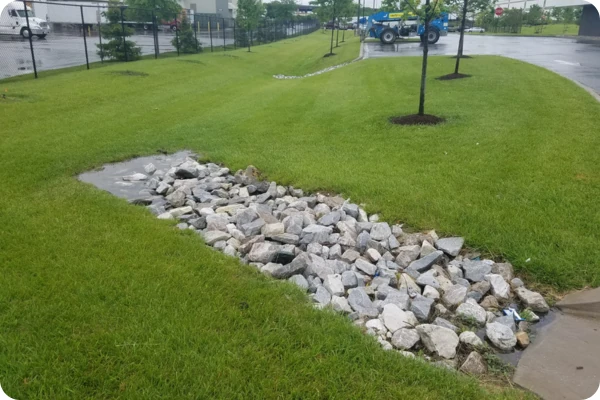
Stormwater facilities are permanent infrastructure. They are designed to control the quantity and/or quality of runoff leaving a developed property, and many require ongoing inspection and maintenance throughout the life of the development.
Depending on the site, stormwater infrastructure may include:
- Detention or retention ponds
- Bioretention facilities and rain gardens
- Sand filters
- Bioswales and drainage channels
- Infiltration practices
- Underground detention systems
- Stormwater vaults
- Hydrodynamic separators and oil-grit separators
- Proprietary filtration systems such as StormFilter or Jellyfish systems
- Catch basins, inlets, manholes, and storm drain piping
- Outfalls and stabilization structures
- Permeable pavement or permeable pavers
The condition of these systems may not be obvious during a conventional property walkthrough. Some facilities are below ground, while problems in aboveground facilities may be hidden by vegetation, sediment, standing water, or years of deferred maintenance.
More importantly, purchasing the property can also mean assuming responsibility for those systems.
In Virginia, for example, long-term stormwater maintenance responsibilities may be established through recorded agreements that run with the land. Washington, DC regulations similarly place responsibility for required stormwater BMP maintenance on property owners or other designated responsible parties. Delaware post-construction stormwater requirements include long-term operation and maintenance planning for stormwater systems. Requirements vary by jurisdiction and property, making review of the property’s actual records essential.
For a buyer, stormwater due diligence is therefore both a physical-condition review and a risk-management exercise.
Is Stormwater Covered by a Phase I Environmental Site Assessment?
A Phase I Environmental Site Assessment, or Phase I ESA, is an important part of many commercial real estate transactions. However, buyers should not assume that a Phase I automatically provides a complete assessment of the property’s stormwater infrastructure.
The primary purpose of the ASTM E1527 Phase I process is to identify recognized environmental conditions associated with hazardous substances and petroleum products. ASTM also recognizes that broader business environmental risks can require investigation beyond the standard scope of a Phase I ESA.
That distinction matters.
A Phase I may identify certain drainage features, environmental concerns, or conditions involving stormwater, but it is not necessarily a detailed evaluation of whether a detention pond needs dredging, a StormFilter requires cartridge replacement, an underground pipe is deteriorating, or a maintenance agreement has been followed.
For properties with significant stormwater infrastructure, a stormwater-specific inspection and document review can complement the environmental due diligence already being performed.
1. Identify Every Stormwater Facility on the Property
The first step is determining what actually exists.
That is not always as straightforward as it sounds.
Older properties may have facilities that are poorly documented. Underground systems may be invisible from the surface. Previous renovations may have changed drainage patterns or added stormwater controls. Plans may also use terminology that differs from what a buyer sees in the field.
Review available:
- Approved stormwater management plans
- As-built drawings
- Site development plans
- Drainage plans
- Utility plans
- Operations and maintenance documents
- Recorded stormwater agreements or covenants
- Previous inspection reports
Then compare those records with conditions in the field.
A property plan might show an underground sand filter, detention system, or proprietary treatment device underneath an area that now appears to be nothing more than pavement and a few access covers.
Knowing what you own is the starting point for understanding what you may be responsible for maintaining.
2. Determine Who Is Responsible for Maintenance
Never assume the municipality maintains a stormwater facility simply because it serves a regulatory purpose.
Many stormwater management practices located on private commercial properties are privately maintained.
Maintenance responsibilities may be established through:
- Deed records
- Maintenance agreements
- Declarations or covenants
- Approved stormwater management plans
- Easements
- Shared-maintenance agreements
- Development agreements
- Other recorded land records
This issue is particularly important when multiple parcels, shopping centers, office parks, condominium structures, or shared drainage systems are involved.
One property may contain the physical facility while several parcels contribute runoff to it. Conversely, a property being purchased may have a financial or maintenance obligation associated with a facility located elsewhere.
Do not rely solely on what the seller believes the arrangement to be. The recorded documents and applicable local requirements should be reviewed as part of the transaction.
3. Request the Property’s Stormwater Inspection and Maintenance History
Past records can reveal a great deal about the condition of a stormwater system.
Ask the seller for available:
- Routine inspection reports
- Government or municipal inspection reports
- Maintenance records
- Contractor service reports
- Repair records
- Cleaning or sediment-removal records
- CCTV inspection reports
- Pumping or vacuuming documentation
- Filter or cartridge replacement records
- Correspondence with regulatory agencies
- Notices of violation
- Deficiency notices
- Corrective-action documentation
Look for patterns rather than simply confirming that records exist.
Was the facility inspected but recommended repairs never completed?
Has the same deficiency appeared repeatedly?
Was an underground system supposed to be serviced periodically but there is no maintenance history?
Has sediment been accumulating in a pond for years without removal?
Are there gaps in the records?
A lack of documentation does not automatically mean the system has been neglected, but it can create uncertainty that warrants closer investigation.
4. Have the Stormwater System Physically Inspected
Documents tell only part of the story.
A stormwater inspection performed as part of acquisition due diligence can help establish the property’s current condition before ownership changes.
The inspection should be appropriate for the systems present on the site.
For aboveground facilities, inspectors may evaluate conditions such as:
- Sediment accumulation
- Erosion
- Embankment condition
- Inlet and outlet condition
- Vegetation problems
- Clogged or damaged structures
- Standing water where it should not remain
- Deteriorated riprap
- Outlet protection
- Evidence of uncontrolled flow
- Access for future maintenance
Belowground infrastructure can require a different evaluation. Potential concerns may include:
- Sediment and debris accumulation
- Loaded or damaged filter components
- Damaged access structures
- Blocked pipes
- Corrosion
- Joint separation
- Structural deterioration
- Evidence of surcharging or poor drainage
Not every underground condition can be determined visually from the surface. Where there are signs of a potential pipe problem – or where the history and condition of important drainage infrastructure are unknown – a CCTV inspection may provide additional information about the inside of the system.
The objective is not simply to determine whether the property “passes” an inspection. It is to understand what condition the infrastructure is in and what work may reasonably be expected after acquisition.
5. Look for Deferred Maintenance
Deferred stormwater maintenance is one of the biggest issues a buyer can inherit.
A facility may still be functioning while significant maintenance has accumulated.
Examples include:
- Heavy sediment buildup in ponds or forebays
- Vegetation blocking inlets or outlets
- Overgrown embankments
- Clogged catch basins
- Accumulated material in underground treatment devices
- Filter cartridges approaching or exceeding their service needs
- Clogged permeable pavement
- Erosion around structures
- Damaged outfalls
- Obstructed drainage channels
- Deteriorating stormwater pipes
Individually, some maintenance items may be manageable. When years of deferred work are discovered across several facilities, however, the cost can become significant.
This is why stormwater due diligence should consider more than immediate failure.
The more useful question is:
What work is likely to be necessary during the first several years of ownership?
6. Check for Existing Deficiencies or Compliance Issues
A property can look perfectly functional while still having unresolved stormwater deficiencies.
Buyers should determine whether the property has:
- Open Notices of Violation
- Outstanding inspection deficiencies
- Required corrective work
- Unsubmitted documentation
- Missed maintenance requirements
- Unresolved drainage complaints
- Previous enforcement correspondence
An unresolved stormwater issue discovered after closing can put the new owner in the position of addressing a problem that developed years before the acquisition.
That does not necessarily make the property a bad purchase. It does mean the issue should be understood before the transaction is completed.
If deficiencies are found, buyers and their advisors can determine whether they should be corrected before closing, reflected in negotiations, incorporated into capital planning, or handled through another transaction-specific arrangement.
7. Understand the Cost of Upcoming Repairs and Maintenance
A stormwater inspection becomes significantly more useful during due diligence when identified conditions can be translated into anticipated work.
For example, discovering sediment in a facility is one thing.
Understanding whether it requires routine cleaning, excavation, dredging, specialized vacuum equipment, filter replacement, pipe repair, or significant rehabilitation provides far more useful information to an acquisition team.
Potential costs might involve:
Routine maintenance:
Vegetation management, debris removal, catch basin cleaning, vacuuming, filter cleaning, and similar recurring services.
Corrective maintenance:
Erosion repair, sediment removal, restoration of drainage channels, replacement of damaged components, or repairs identified during inspection.
Capital repairs:
Pipe rehabilitation, structural repairs, major pond restoration, substantial excavation, replacement of underground components, or other significant infrastructure work.
Distinguishing among these categories can help owners develop a realistic post-acquisition stormwater budget rather than discovering major needs after the purchase.
8. Evaluate Maintenance Access
A stormwater facility may be perfectly maintainable in theory but expensive to service because of poor access.
Look at whether contractors can realistically reach the system with the equipment required to maintain it.
Potential access constraints include:
- Fences or locked areas
- Limited vehicle access
- Steep slopes
- Parking structures
- Buildings constructed near facilities
- Landscaping blocking access points
- Buried or paved-over structures
- Restricted equipment staging areas
- Confined spaces
A vacuum truck that cannot get near an underground vault or a pond that cannot be reached by excavation equipment can substantially change how maintenance must be performed.
Access should therefore be considered part of the infrastructure itself – not an afterthought.
9. Consider Changes Planned After Acquisition
A property’s existing stormwater system was designed around a particular site layout and land use.
If the buyer intends to redevelop the property, expand buildings, modify parking areas, increase impervious surface, or substantially alter drainage patterns, stormwater requirements may become part of the redevelopment process.
The buyer’s engineer, civil design team, and applicable reviewing authority should determine what requirements apply to the planned work.
An existing system that adequately serves the current property should not automatically be assumed to satisfy future development plans.
This is especially important when stormwater infrastructure occupies land that a buyer hopes to use differently.
A detention facility, drainage easement, underground vault, access easement, or required treatment area may affect what can realistically be constructed on the site.
10. Build Stormwater Into the Acquisition Budget
One of the most valuable outcomes of due diligence is eliminating surprises.
After the stormwater systems have been identified, records reviewed, and current conditions evaluated, the buyer should have a clearer picture of:
- Immediate maintenance needs
- Known deficiencies
- Recommended repairs
- Recurring inspection requirements
- Routine maintenance expenses
- Potential capital projects
- Longer-term rehabilitation needs
That information can become part of the property’s operating and capital planning from the beginning.
A neglected stormwater system does not necessarily mean a property should be avoided. But unknown stormwater conditions make it much harder to accurately evaluate the cost of ownership.
Stormwater Due Diligence Checklist for Commercial Property Buyers
Before closing on a commercial property, consider verifying:
- What stormwater facilities are located on the property?
- Are approved stormwater plans and as-built drawings available?
- Who is legally responsible for each facility?
- Are there recorded maintenance agreements, covenants, or easements?
- When were the facilities last inspected?
- Is previous inspection documentation available?
- What maintenance has been performed?
- Are there outstanding deficiencies?
- Are there open stormwater violations or agency correspondence?
- Does the physical condition match the available records?
- Are underground systems accessible and in serviceable condition?
- Is additional investigation, such as CCTV pipe inspection, warranted?
- Is maintenance access adequate?
- What repairs or maintenance are likely in the near term?
- What recurring maintenance should be included in the operating budget?
- Could planned redevelopment affect the existing stormwater system?
The exact level of investigation should depend on the property, its stormwater infrastructure, local requirements, and the buyer’s plans for the site.
Know What You’re Acquiring Before You Close
Stormwater infrastructure is easy to overlook during a commercial property transaction because much of it sits underground, behind a building, at the edge of a parking lot, or within areas buyers rarely focus on during a property tour.
But after closing, maintaining that infrastructure may become the new owner’s responsibility.
Reviewing stormwater records, identifying maintenance obligations, inspecting the existing facilities, and evaluating deferred maintenance before acquisition can provide a much clearer picture of the property’s actual condition and future costs.
For buyers, investors, property managers, and commercial real estate teams evaluating properties in Maryland, Washington, DC, Northern Virginia, and Delaware, iSTORMWATER can inspect existing aboveground and belowground stormwater facilities and help identify maintenance, repair, and rehabilitation needs before they become post-closing surprises.
Considering a commercial property acquisition? Contact iSTORMWATER to schedule a stormwater system inspection and better understand the condition of the infrastructure you may be acquiring.
📞 Call us at (410) 231-3455 or 💬 Contact us online.


Real Results
iStormwater LLC was an excellent choice. They made the process of the Stormwater pond repairs seamless. They took charge of the project and got the project approved and passing the inspection. We highly recommend them and would use them again.
Incredible stormwater management service. The owner John consulted on a property I manage and ended up saving us thousands of dollars in environmental fees from the government. Now, our property is compliant with the EPA and we have a great partner to keep us maintained on stormwater regulations over time.
So helpful with all of my water issues.
Great communication and leadership and a family friendly atmosphere. Thank you John!
Buying a commercial property means evaluating much more than the building, parking lot, roof, utilities, and financials. The property's stormwater management system can carry its...
- Annapolis
- Anne Arundel County
- Baltimore County
- Baltimore
- Bel Air South
- Bethesda
- Bowie
- Cecil County
- Charles County
- Columbia
- Gaithersburg
- Glen Burnie
- Howard County
- Montgomery County
- Pasadena
- Prince George’s County
- Rockville
- Severna Park
- St. Mary’s County