

Why Is There Standing Water Around My Storm Drain?
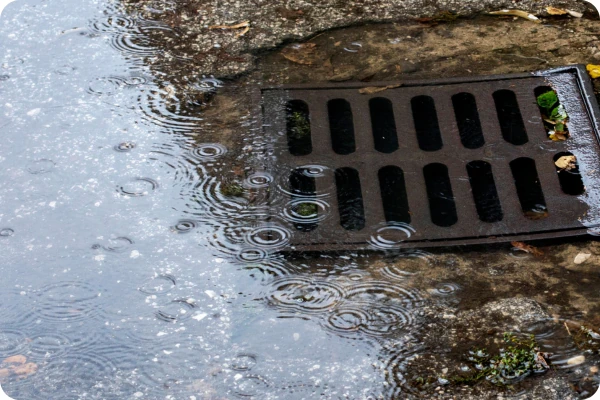
Standing water around a storm drain often looks like a simple clog.
Sometimes it is. But when the grate is clear and water is still pooling nearby, the cause may have less to do with the visible drain and more to do with how runoff is reaching – or moving through – the drainage system.
Water has to follow a complete path: across the surface, into the inlet, through the catch basin, into connected piping, and eventually downstream. If something interrupts that path, water can collect at the surface even when the drain itself appears open.
For property managers and facility owners, the location and pattern of standing water can provide important clues about what is actually going wrong.
A Clear Storm Drain Does Not Always Mean a Clear Drainage System
The first thing most people check is the grate.
If leaves, trash, sediment, or other debris are covering the inlet, the problem may be obvious. But a clear grate only tells you that the opening is visible.
It does not tell you:
- Whether sediment has accumulated below the grate
- Whether the catch basin outlet is restricted
- Whether the connected pipe is partially blocked
- Whether the surrounding surface is directing water toward the inlet correctly
- Whether the problem is farther downstream
That is why recurring ponding should be evaluated as a drainage-path problem, not just a surface-cleaning problem.
Is the Water Actually Reaching the Drain?
One of the most overlooked causes of standing water is surface grading.
Storm drains are typically installed at low points so runoff naturally moves toward them. But over time, pavement and surrounding surfaces can change.
Settlement, resurfacing, patching, curb work, or deterioration can create low areas that trap water before it reaches the inlet.
In some cases, the drain may actually sit slightly higher than the surrounding surface.
That creates a situation where the storm drain is completely clear, but water still ponds beside it.
Signs the problem may be surface grading
Look closely at where the water collects.
If the deepest portion of the puddle is beside the drain rather than directly over it, or if water stops short of reaching the inlet, surface elevation may be part of the problem.
You may also notice:
- Depressions in pavement
- Cracking or settlement near the inlet
- Water collecting along curbs
- Ponding that remains even though the drain itself is dry
- Drainage problems that began after resurfacing or repair work
In these cases, cleaning the drain will not solve the underlying issue because the runoff is not reaching it properly in the first place.
What If the Water Is Directly Over the Drain?
If water is ponding directly over the inlet, the problem may be inside the structure or downstream from it.
The next question is whether water can enter the system but cannot move through it quickly enough.
Sediment May Be Accumulating Inside the Catch Basin
Many storm drains discharge into catch basins designed to collect runoff while allowing heavier sediment and debris to settle.
Over time, that material can build up.
A catch basin may still look open from above while accumulated sediment reduces available space or interferes with the outlet.
That can slow drainage and cause water to remain at the surface longer after rainfall.
This is especially important on properties where drains receive runoff from parking areas, roadways, loading zones, or other surfaces that contribute sediment and debris.
If sediment buildup is the issue, routine catch basin cleaning may restore flow.
If the basin is relatively clean, the problem may be farther downstream.
The Outlet Pipe May Be Restricted
Once water enters the catch basin, it still has to leave through the outlet pipe.
That pipe can become partially restricted by:
- Sediment
- Debris
- Roots
- Displaced material
- Pipe deformation
- Structural damage
A partial restriction is often harder to notice than a complete blockage.
The system may still drain eventually, but not fast enough.
That can lead to a common pattern: water ponds around the drain during rainfall, then slowly disappears after the storm ends.
This kind of delayed drainage may indicate that the system is still functioning, but with reduced capacity.
Water Beside the Drain vs. Water Over the Drain
The location of the ponding can help narrow down the cause.
Water collecting beside the drain
This may point toward:
- Surface grading problems
- Pavement settlement
- Depressions or low spots
- Runoff bypassing the inlet
Water directly over the drain
This may point toward:
- Sediment inside the catch basin
- A restricted outlet
- A partially blocked pipe
- A downstream backup
This distinction is not a complete diagnosis, but it is a useful first step.
One Slow Drain or Several?
Another clue is how many drainage structures are affected.
Only one drain is slow
If one inlet is ponding while nearby drains are functioning normally, the problem may be localized.
Possible causes include:
- Sediment in that catch basin
- A blockage in the connecting pipe
- Localized pavement settlement
- Damage near that structure
Several drains are slow at the same time
If multiple nearby drains are backing up together, the issue may be in a shared downstream pipe or structure.
That does not necessarily mean the entire stormwater system is overflowing. It may simply indicate that several inlets depend on the same restricted downstream connection.
The pattern matters.
Does the Water Drain Slowly or Not at All?
How the standing water behaves after the storm can also provide useful information.
Water drains slowly over time
This often suggests that flow is restricted but not completely stopped.
Possible causes include:
- Partial pipe blockage
- Sediment buildup
- Reduced outlet capacity
- Minor downstream restrictions
Water remains long after surrounding areas are dry
This may point toward:
- A low spot or grading problem
- A more severe blockage
- A damaged or disconnected pipe
- A drainage path that no longer functions as intended
Persistent ponding should be investigated differently from temporary ponding during intense rainfall.
Has the Area Always Drained This Way?
Changes over time are important.
A property that has always experienced brief ponding during very heavy storms is different from one where standing water has recently started appearing after routine rainfall.
Ask:
- Did this area used to drain faster?
- Is the water covering a larger area than before?
- Is ponding occurring during smaller storms?
- Did the problem begin after paving or construction work?
- Has the same drain already been cleaned?
A change in drainage behavior often provides a better clue than the puddle itself.
Could Pavement or Site Work Have Changed Drainage?
Stormwater drainage depends heavily on elevations.
Even relatively small changes to the surface can redirect runoff.
Potential causes include:
- Parking lot resurfacing
- Asphalt overlays
- Concrete repairs
- New curbing
- Sidewalk installation
- Utility work
- Pavement settlement
- Changes to landscaped areas
For example, adding a new layer of pavement around an existing inlet can alter the relationship between the drain and surrounding surface.
If standing water begins after site work, the drainage elevations should be part of the investigation.
What If Cleaning the Drain Did Not Fix the Problem?
This is one of the clearest signs that the problem may be somewhere else.
If a drain has already been cleared or vacuumed and standing water continues to return, repeating the same maintenance may not solve the issue.
The next step may be to evaluate:
- The catch basin outlet
- The connecting pipe
- Surface grading around the inlet
- Nearby structures connected to the same line
Depending on the conditions, CCTV pipe inspection, jetting, vacuum services, or a broader stormwater inspection may help identify the cause.
The important point is to avoid assuming that recurring ponding automatically means the same drain needs to be cleaned again.
When Standing Water May Not Be a Drain Problem at All
Not every puddle near a storm drain is caused by the stormwater system.
Water may also come from:
- Irrigation
- Broken water lines
- Groundwater
- Roof drainage
- Condensate
- Other site drainage sources
If water appears during dry weather or remains long after rainfall has ended, it may be worth confirming where the water is coming from before focusing on the storm drain itself.
How to Diagnose Standing Water Around a Storm Drain
A useful approach is to work from the surface downward.
1. Look at the ponding pattern
Is the water over the drain, beside it, or nowhere near it?
2. Check whether runoff can reach the inlet
Look for low spots, settlement, or grading changes.
3. Inspect below the grate
Check for sediment or debris inside the catch basin.
4. Evaluate the outlet
Determine whether water is leaving the structure properly.
5. Investigate connected piping if needed
If the visible structure is clear, a pipe restriction or structural issue may require further inspection.
This step-by-step approach helps separate surface drainage problems from belowground drainage problems.
When Does Standing Water Need Attention?
Temporary ponding during an unusually intense storm does not automatically indicate a failure.
The bigger concern is recurring or worsening ponding.
Consider further investigation if:
- Water is taking longer to drain than it used to
- Ponding occurs after relatively minor rainfall
- The same area repeatedly holds water
- The inlet has already been cleaned
- Several nearby drains are becoming slow
- Pavement is settling around the drain
- Water remains well after surrounding areas have dried
These patterns may indicate that drainage performance is changing.
Why Finding the Cause Matters
Standing water is a symptom, not a diagnosis.
Cleaning a catch basin may solve sediment buildup, but it will not correct poor grading.
Jetting a pipe may remove an obstruction, but it will not repair pavement settlement.
Likewise, resurfacing a low area will not help if the outlet pipe is blocked.
Identifying where the drainage path is being interrupted helps determine whether the property needs routine maintenance, surface correction, pipe cleaning, inspection, or repair.
The Bottom Line: Look Beyond the Grate
If there is standing water around a storm drain, checking the grate is a good first step.
It should not always be the last one.
The most useful question is not simply, “Is the drain clogged?”
It is:
“Where is the water being prevented from moving?”
If water cannot reach the inlet, the problem may be grading or settlement.
If it reaches the inlet but drains slowly, the issue may be inside the catch basin or connected piping.
If several nearby drains are affected, the problem may be in a shared downstream connection.
Understanding those differences can help property managers address the actual drainage problem instead of repeatedly treating the visible symptom.
iSTORMWATER provides stormwater inspections, catch basin maintenance, vacuum and jetting services, CCTV pipe inspections, and stormwater repairs throughout Maryland, Washington, DC, Northern Virginia, and Delaware.
If standing water around a storm drain keeps returning, our team can help evaluate the drainage path and determine the appropriate next step.
📞 Call us at (410) 231-3455 or 💬 Contact us online.



Real Results
iStormwater LLC was an excellent choice. They made the process of the Stormwater pond repairs seamless. They took charge of the project and got the project approved and passing the inspection. We highly recommend them and would use them again.
Incredible stormwater management service. The owner John consulted on a property I manage and ended up saving us thousands of dollars in environmental fees from the government. Now, our property is compliant with the EPA and we have a great partner to keep us maintained on stormwater regulations over time.
So helpful with all of my water issues.
Great communication and leadership and a family friendly atmosphere. Thank you John!
Belowground stormwater treatment systems do a significant amount of work out of sight. While the surface of a property may appear clean and well-maintained, underground...
- Annapolis
- Anne Arundel County
- Baltimore County
- Baltimore
- Bel Air South
- Bethesda
- Bowie
- Cecil County
- Charles County
- Columbia
- Gaithersburg
- Glen Burnie
- Howard County
- Montgomery County
- Pasadena
- Prince George’s County
- Rockville
- Severna Park
- St. Mary’s County